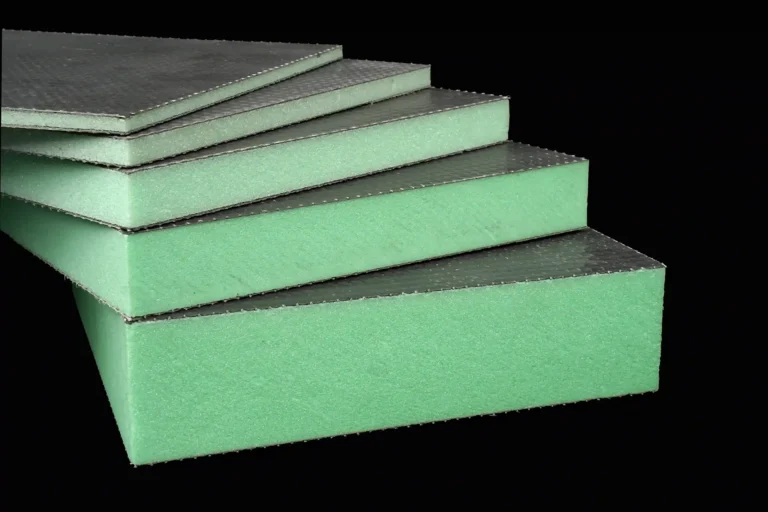
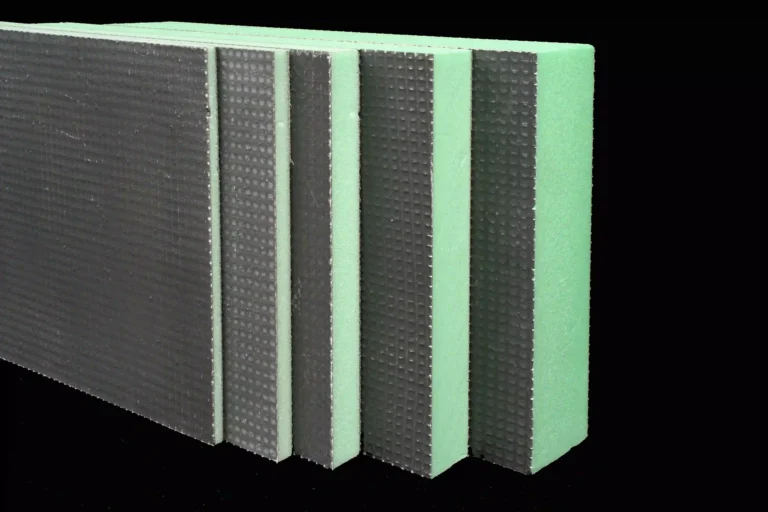
An XPS tile backer board is a rigid composite panel used as a substrate beneath tile, stone or mosaic. It has a closed-cell extruded polystyrene core, with alkali-resistant fiberglass mesh and a polymer-modified cement coating on both faces. The core provides moisture resistance and thermal insulation; the reinforced faces provide a firm, tile-bonding surface.
That makes it different from a bare XPS insulation sheet. It also means that the board alone is not the complete waterproofing or structural design. Joints, corners, fasteners, penetrations and support still have to be resolved as part of the installation.
A composite tile substrate, not a bare foam sheet
XPS stands for extruded polystyrene. In a tile backer board, that foam is the middle of a factory-made composite rather than the finished working surface.
The construction contains three material components:
| Component | Its job in the board | What it should not be mistaken for |
|---|---|---|
| Closed-cell XPS core | Reduces water absorption, provides thermal insulation and gives the panel its rigid foam body | A finished tile-bonding surface or an automatic structural support |
| Alkali-resistant fiberglass mesh on both faces | Reinforces the cement-based face layers and helps them resist cracking | A decorative fabric or a substitute for joint tape at installed seams |
| Polymer-modified cement coating on both faces | Creates the firm surface to which compatible tile adhesive can bond | A finish that removes the need to seal installed joints and penetrations |
Some descriptions call this a five-layer panel because the mesh and coating on each face are counted separately. Both descriptions refer to the same basic construction: one XPS core with reinforced, cement-coated faces.
The mesh is part of the board faces during manufacture. Separate mesh tape or sealing tape is still used at board joints during installation. Those are two different details and should not be confused.
XPS, EPS and cement board: names that get mixed up
XPS and EPS are both polystyrene foams, but they are not the same product. XPS is extruded polystyrene; EPS is expanded polystyrene. Their manufacturing routes and cell structures differ, so a datasheet for one should not be borrowed to describe the other.
A bare foam sheet is also different from a tile backer board. A bare XPS or EPS sheet may provide insulation, but it does not automatically have the reinforced cement-based faces required for a tile-bonding substrate. The composite faces and their bond to the core are part of the product, not an optional description.
Finally, a cement-coated XPS board is not a traditional solid cement board. The former has a lightweight foam core with reinforced coatings; the latter has a fundamentally different construction. Weight, handling, fixing, fire requirements and project suitability should therefore be compared as complete systems rather than inferred from the word “cement” on the surface.
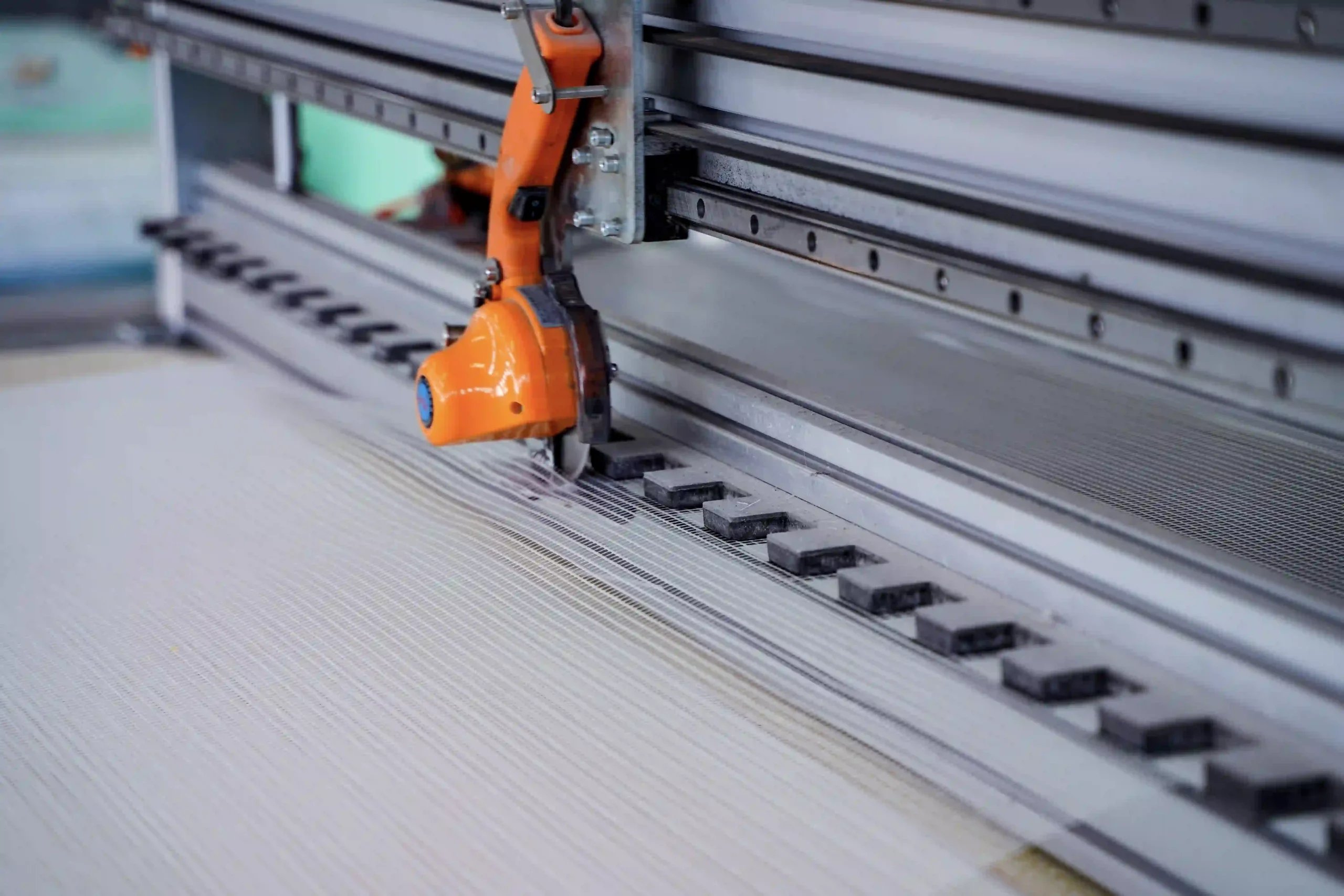
Why we extrude our own XPS core
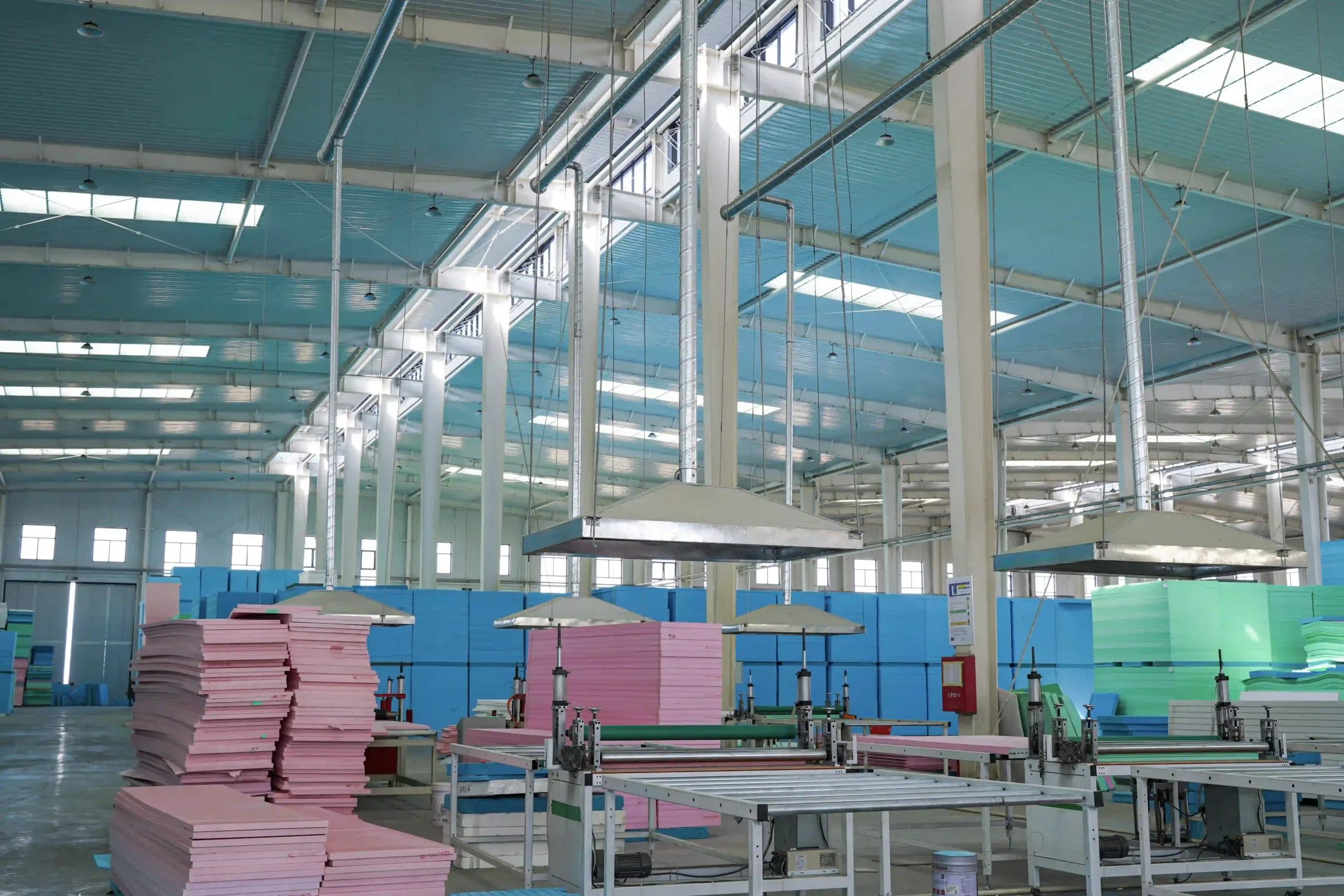
We extrude the XPS core in our own factory rather than purchasing a finished core from an outside supplier. This gives us direct control over core density, thickness, raw-material settings and production scheduling before the fiberglass mesh and polymer-modified cement coating are applied.
Our XPS production began in 1996. That date describes our experience with XPS production, not the launch date of every composite backer-board product we now supply.
For a buyer, the practical benefit is fewer handoffs. One factory can confirm the core specification, the composite-board construction and the order plan together. A required density or thickness can be reviewed against the extrusion process before the board reaches the coating and finishing stages.
This integrated production also reduces dependence on an outside core supplier. It gives us more direct control over scheduling, but it is not a blanket delivery guarantee. The confirmed specification, order quantity, downstream processing, inspection, packaging and shipping plan still determine the actual order schedule.
The same distinction applies to cost. In-house extrusion removes some purchasing and transfer steps, but it does not prove that every specification will always cost less than every alternative. A meaningful comparison requires the same board construction, dimensions, test scope, quantity and delivery terms.
The properties that matter, and what they actually prove
A useful specification should connect a number to a decision. It should also keep the test condition attached to the result. The following figures are our current board data, not universal values for every XPS backer board on the market.
| Property | Current factory data | Practical meaning and limit |
|---|---|---|
| Standard core density | 35 kg/m³ | A production specification for the core; do not calculate it by weighing a finished coated board |
| Water absorption | 0.8% by weight after 96 h immersion | Evidence of low water uptake under the stated test; not a promise that an unsealed installation is watertight |
| Thermal conductivity | 0.030 W/(m·K) at 25 °C | Useful when comparing insulation behaviour; the performance of a complete floor or wall still depends on the whole construction |
| Compressive strength | 361 kPa at 10% deformation | A material test result, not the allowable design load for every floor, support spacing or tile assembly |
| Bending load | 1,842 N for a 12 mm board | A result for the stated board and test context, not a universal span or point-load rating |
| Layer bond strength | 0.42 MPa, with failure recorded in the core | Evidence about the composite bond under the corresponding test, not proof that every adhesive and site combination will behave identically |
| Wet dimensional change | 0.04% | A measured stability value under its test conditions, not a claim that no movement can occur in a complete assembly |
| Mold resistance | Grade 0 in the corresponding test | A test result for the evaluated material, not a guarantee that mold can never grow anywhere in a real bathroom |
These numbers work together. Low water uptake without a stable tile-bonding face is not enough. A firm coating without a consistent core is not enough either. The product has to be assessed as a composite and then as part of an installed system.
For a closer look at why coated-board weight cannot be used as a direct measurement of core density, read our guide to XPS backer board density.
A water-resistant board is not automatically a waterproof room
The closed-cell XPS core gives the board its resistance to water absorption. In product descriptions, this is often shortened to “waterproof backer board.” That shorthand is useful only if the next question is also answered: what happens at the joints and openings?
A real installation can include board-to-board joints, internal and external corners, screw and washer positions, pipe openings, valve penetrations, niches, curbs and a tray connection. Each of these details needs the treatment specified by the chosen system.
The factory-applied mesh in the board faces does not seal the joints between installed boards. The cement coating does not seal a newly cut pipe opening. Neither detail removes the need for the specified sealant, tape, washers, sleeves or other system components.
This is why we separate three levels of performance:
- The XPS core and its measured water absorption.
- The composite board, including its reinforced cement-coated faces.
- The installed wet-room system, including support, joints, corners, penetrations and drainage connections.
A photograph or datasheet for level one cannot prove level three. The installation instructions and project inspection remain necessary.
Fire, vapor and sound claims need their own context
Water resistance does not establish fire performance. XPS is a combustible polymer, and a cement-based face does not make the whole composite non-combustible. Where a project requires a fire classification, request the classification or report for the exact product and relevant assembly. “Waterproof” must never be read as “fireproof.”
Low water absorption also does not automatically make the board a vapor barrier. Vapor control depends on the required permeance, board thickness, joints, climate, interior conditions and the complete wall or floor design. If a separate vapor-control layer is specified, the board description alone does not remove it.
Sound figures need the same discipline. Our reported Rw,P value of 23 dB applies to a 12 mm board under its material test context. It is not the airborne sound insulation of every finished wall. Studs, cavities, insulation, layers, junctions, penetrations and installation quality can all change the result of a complete assembly.
These are not reasons to dismiss the board. They are reasons to keep material data, assembly performance and project compliance in their proper places.
Where the handling and insulation benefits matter
A foam-cored composite board is easier to handle than many traditional heavy board constructions, especially in renovation work, narrow bathrooms and projects with repeated cuts. The benefit is most visible when an installer has to carry, position and fit numerous panels or shaped components.
Cutting still needs to match the board and the current installation guide. Our current guidance includes utility-knife cutting for the applicable 12 mm board; other thicknesses and products may require a hand saw or suitable power tool. “Easy to cut” does not mean that every thickness can be cut with the same blade and motion.
Cutting should not be described as dust-free. The correct comparison is that suitable foam-board cutting methods can reduce the heavy cutting and dust associated with many cement-based boards. Normal workshop extraction, housekeeping and personal protection still apply.
The XPS core also provides thermal insulation. This can be useful in bathroom floors and underfloor-heating constructions where heat-loss direction matters. It does not replace the heating design, the required floor build-up or the project’s thermal calculations.
Common applications, with the support question kept separate
The same basic composite can be used in several parts of a wet-room project:
- Tile backing on suitably designed steel or timber stud walls.
- Board installed over a confirmed solid backing.
- Bathroom and wet-room floors over an appropriate continuous substrate.
- Pipe boxing, concealed-cistern surrounds and custom wet-room components.
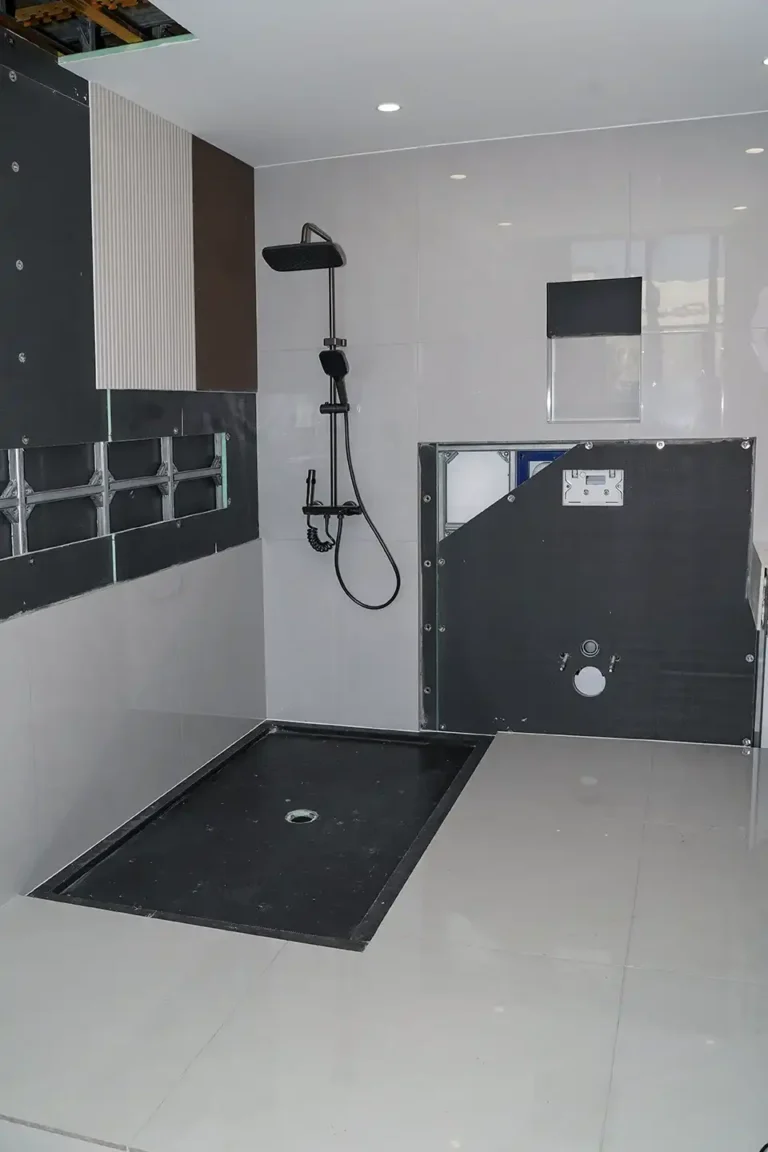
- Prefabricated trays, curbs, niches, benches and bathtub panels.
- Grooved boards designed for particular underfloor-heating pipe layouts.
The application changes the questions that need to be asked. A wall board needs the correct support spacing and fixing pattern. A floor needs continuous support and a reviewed build-up. A prefabricated tray needs the correct footprint, drain geometry and permitted trimming zone. A heated floor needs a board and groove layout designed for that system.
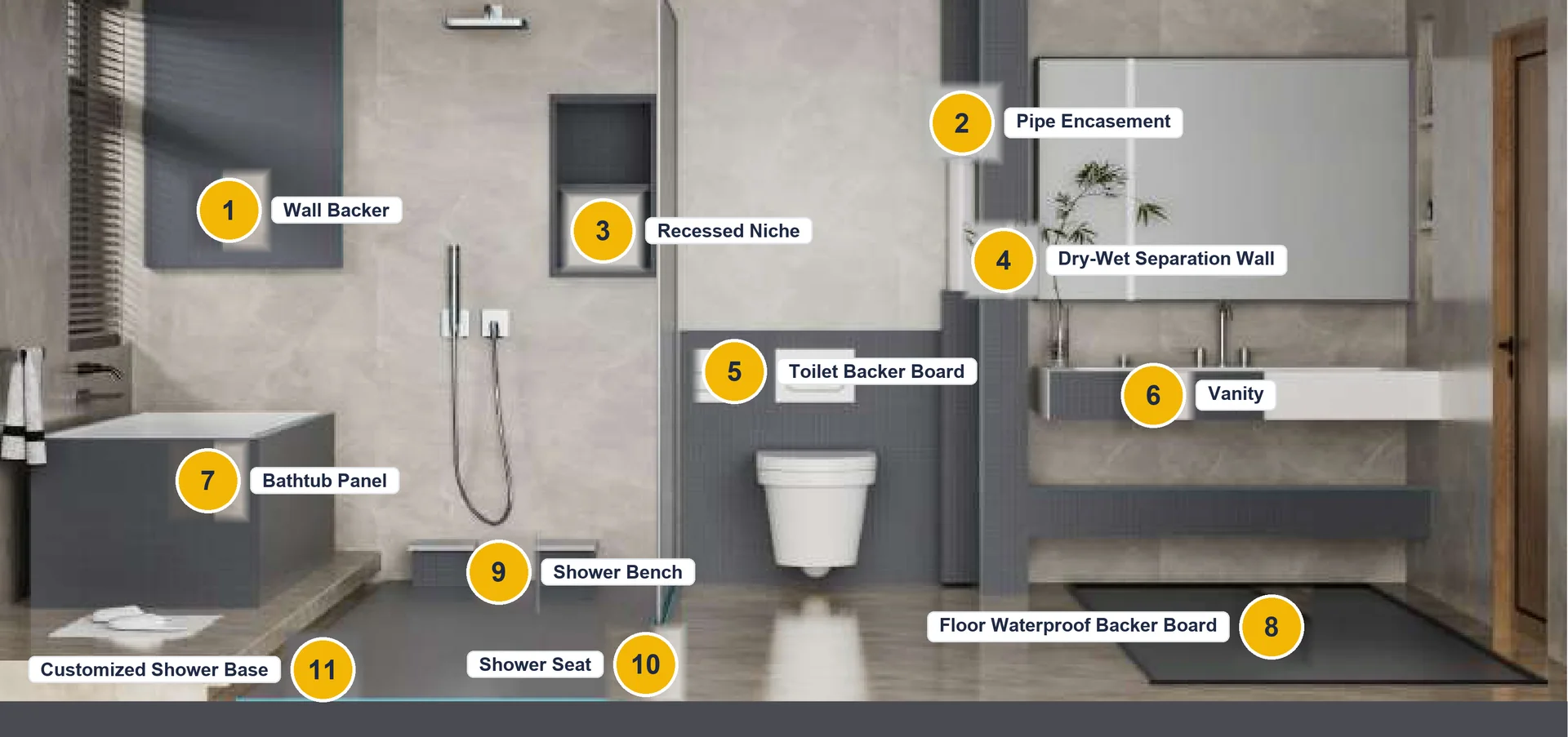
The board is not a default structural anchor. Wall-hung toilets, washbasins, grab bars, heavy cabinets and other concentrated loads need a designed frame, blocking or other suitable support. The backer board can provide the moisture-resistant, tileable skin around that support; it should not be asked to replace it.
Available forms, thicknesses and sizes
Our standard flat-board range covers thicknesses from 4 to 50 mm, with custom production available for review from 4 to 100 mm. The standard sheet size is 1,220 × 2,440 mm. Custom lengths from 600 to 3,100 mm and widths from 300 to 1,220 mm can be reviewed against the required construction and order.
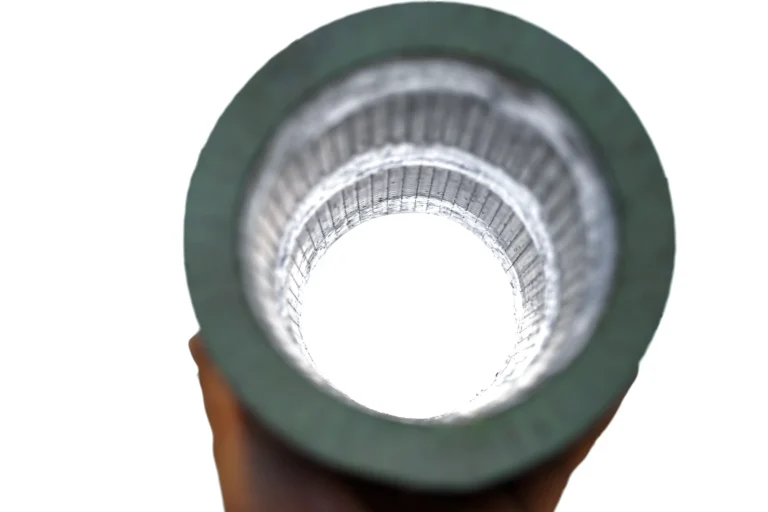
The product family is not limited to flat sheets. It also includes shaped wet-room components such as shower trays, curbs, niches, benches, pipe-boxing sections and curved boards. These components have their own dimensions, support conditions and installation details; a flat-board datasheet cannot answer every question about a shaped component.
Do not convert an inch-model name into a millimetre specification by assumption. Nominal inch sizes and metric board thicknesses are not always numerically identical, so the confirmed production dimension and tolerance should appear on the order.
Core or coating colour is a product-identification feature, not a reliable performance grade. Green, blue, pink or another colour does not by itself establish density, strength, water absorption or certification. Review the specification and evidence instead.
A basic installation sequence
The exact method depends on the application and current guide, but the decision sequence is consistent:
- Confirm the support and substrate. Check stud spacing, continuous backing, flatness, load requirements and the complete wall or floor build-up before selecting the board.
- Plan and cut the components. Lay out joints, corners, openings and shaped parts, then cut with tools suitable for the actual thickness and product. Control dust and keep cut edges clean.
- Fix or bond as specified. On framing, use the specified fasteners, washers and spacing. On a suitable continuous substrate, use the compatible adhesive and coverage required by the guide. One method does not fit every application.
- Complete the waterproof details. Treat joints, corners, fastener positions, penetrations and drainage connections with the specified tape, sealant, washers, sleeves or other system components.
- Inspect before covering. Check support, fixing, sealing, tray falls and drain connections; carry out any project-required inspection or test before the finish conceals the work.
- Tile when the system is ready. Use a compatible tile adhesive and proceed only after the relevant materials and installation have reached the conditions stated in their instructions.
This sequence is a map, not a substitute for the product-specific installation manual. No single curing time, fastener pattern or adhesive coverage should be imposed on every project.
How to choose a board without relying on adjectives
Start with the application and support, not with a colour or a generic claim such as “strong” or “premium.” Then review these inputs together:
- Thickness: Match the board to the backing, support spacing, component design and required build-up. Do not assume that a thinner board automatically produces a flush finished floor.
- Core specification: Confirm the required density and other core properties as production specifications. Our standard core density is 35 kg/m³; other requirements can be reviewed for the order.
- Board dimensions: Check the actual sheet or component dimensions against the layout, cutting plan and transport requirements.
- Face quality: Review flatness, coating condition, mesh reinforcement, clean edges and the bond between the layers on a real sample.
- System compatibility: Confirm the fixing method, joint treatment, sealant, tape, penetrations and drainage details rather than treating the board as an isolated sheet.
- Evidence: Ask which document applies to the exact product and claim. A management certificate, a material test and a system listing answer different questions.
Our 4–50 mm XPS tile backer board range covers standard and custom specifications within the stated range. The final selection still depends on the application, support and project requirements.
If the alternative is a traditional cement-based board, compare the complete installation rather than only the sheet. Our XPS and cement board comparison looks at that choice in wet-room conditions. Cement-based or other boards remain appropriate where the project, fire design, finish or applicable code specifically calls for them.
Which documents support the product claims
Documents are most useful when their scope stays attached to them. The following records do not all prove the same thing:
| Document | What it supports | What it does not mean |
|---|---|---|
| CE marked to EN 13164 | The product scope listed under the corresponding EN 13164 documentation | That the factory itself is “CE certified,” or that every possible construction is covered |
| IAPMO PS 106-2015 report J251017003-1 | Results for the shower receptors and kits identified in the report; the report lists 71 models and identifies the specific samples tested | That all 71 models were individually subjected to every test, or that every site installation is guaranteed |
| ICC-ES PMG-1804 | The listed Tileable Shower Systems with Backer Board within the certificate scope; the certification system includes factory inspection and quality-system surveillance | Permission to ignore the published installation instructions or applicable local code |
| ISO 9001, ISO 14001 and ISO 45001 | The factory’s quality, environmental and occupational health and safety management systems within the certified scope | A product-performance test or a substitute for product-specific evidence |
Our IAPMO PS 106 report explainer separates the tested samples from the wider model list. That is the correct way to read any technical document: identify the product, the test or assessment, the conditions and the limit of the claim.
FAQ
Is XPS tile backer board the same as XPS insulation board?
No. A bare XPS insulation board does not automatically have the reinforced, polymer-modified cement faces needed for tile bonding. An XPS tile backer board combines the foam core with fiberglass mesh and cement-based coatings on both faces.
Does the core colour indicate quality?
No. Colour can identify a product or series, but it does not establish density, strength, water absorption or certification. Compare the actual specification and supporting documents.
Is XPS tile backer board waterproof?
The closed-cell core has low water absorption, and the board is designed for wet-area tile substrates. The complete installation still needs the specified treatment at joints, corners, fasteners, penetrations and drainage connections. Do not use the board description as a substitute for system waterproofing.
Do I still need a full-surface waterproof membrane?
When the board is used within its specified waterproof system and the joints, corners, fasteners, penetrations and drainage connections are completed as required, an additional full-surface membrane is not normally required. Project specifications, local requirements or a different chosen system may change that answer. Follow the documented system rather than the board label alone.
Can XPS tile backer board be used on floors?
Yes, when the selected board, continuous substrate, adhesive or fixing method, support and finished-floor build-up are suitable for the project. A material compressive-strength figure alone is not the allowable design load for every floor assembly.
Does the board prevent all bathroom mold?
No such site-wide guarantee should be made. Our corresponding material test records Grade 0 mold resistance under its test conditions. Real bathroom mold risk also depends on ventilation, cleaning, moisture, other materials and the condition of the installation.
Can it replace cement board in every project?
No. The choice depends on the wet-area design, support, finish, fire requirements and applicable code. Compare complete systems and use the material that satisfies the project rather than assuming one board is universally interchangeable with another.
Is XPS tile backer board fireproof?
No. Water resistance and fire performance are different properties. XPS is combustible, and the cement-based coating does not make the complete board non-combustible. Use the applicable product and assembly fire documentation where a fire classification is required.
Can a wall-hung toilet or grab bar be fixed directly to the board?
Not as a default structural fixing. Provide a designed frame, blocking or other suitable support for concentrated loads. The board can then serve as the moisture-resistant, tileable surface around that support.
Is one density or thickness right for every application?
No. Density, thickness, support spacing, substrate, tile or stone, fixing method and finished build-up need to be reviewed together. A standard specification is a starting point, not a universal design answer.
Your turn
Tell us the application, substrate or stud spacing, tile format, required board dimensions and quantity. We will review the core and board specification against the actual use and respond within one working day. If you want to inspect the core, coating and sealing components before deciding, ask for a Project Sample Kit with your specification review.
Send your application and board specification | Compare board and wet-room products | Understand ISO records versus product testing
Need to verify the board before you specify it?
Tell us your application, support, dimensions and quantity. We will confirm the suitable board construction and specification. Ask for a Project Sample Kit if you also need to inspect the core, coating and sealing components.