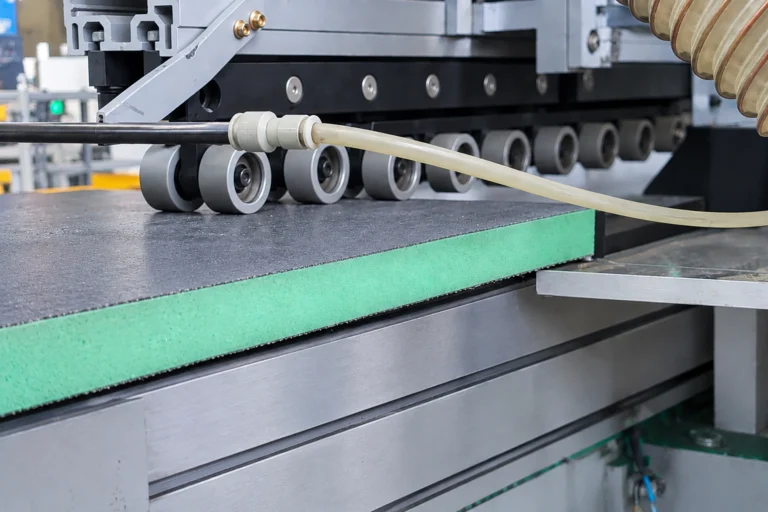
The backer board behind your tile is the layer that decides whether a shower stays dry or fails where nobody can see it. This guide compares traditional cement and fiber-cement board with XPS waterproof backer board on the things that matter—waterproofing, weight, dust, mold, strength, installed cost and code—so homeowners, tile setters and builders can choose and install the right system with confidence.
- Cement board is rigid, familiar and cheap, but it is not waterproof—a shower needs a separate moisture barrier or membrane.
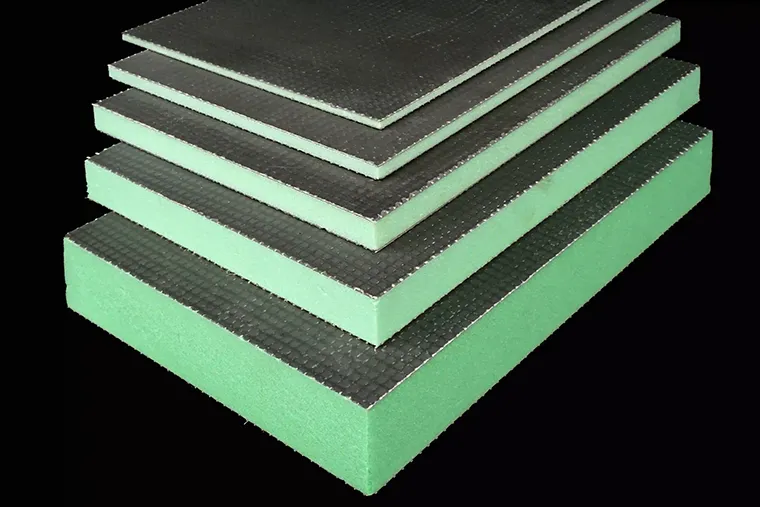
- XPS waterproof backer board is a lightweight, closed-cell, tile-ready panel that is waterproof in itself; seams and penetrations are sealed as one system.
- XPS is far lighter and cleaner to cut and removes the membrane step; cement board costs less per sheet and is familiar to every inspector.
- Both pass inspection when installed as complete, code-recognized systems. Choose on budget, schedule, weight and the assembly your crew knows.
In this guide: What cement board is · What XPS backer board is · Side-by-side table · The differences that matter · Two assemblies step by step · Failures that fail inspection · Which to choose · FAQ
The tile and grout get all the attention in a shower remodel. The layer nobody sees—the backer board—is what decides whether the walls stay flat, stay dry, and actually last. Pick the wrong backer and the failure stays hidden until it is not: soft spots, drummy or loose tile, a musty smell, or mold on the framing behind a wall that looked perfect six months ago.
This guide compares traditional cement board with XPS waterproof backer board on the things that change your bid or your weekend: waterproofing, weight, cutting and dust, mold, insulation, strength, installed cost and code. It is written for homeowners planning a shower, tile setters pricing jobs, and builders standardizing assemblies. We will also tell you where cement board is still the right call—no single product wins every job. For the whole-room sequence, see our guide to building a fully waterproof tiled shower.
What Is Cement Board?
Cement board is the older, familiar option. Cement backer units (CBUs)—USG Durock is the classic example—are made from Portland cement and aggregate reinforced with fiberglass mesh. Fiber-cement backer boards, such as James Hardie’s HardieBacker, use a cement-and-fiber formula. Both are commonly grouped as “cement board.”
- Inorganic and stable. It will not rot, delaminate or feed mold the way a paper-faced gypsum panel can, and it stays dimensionally stable when wet.
- A rigid, grippy base. It gives thin-set mortar and tile a stiff surface on walls and floors, and every supplier and inspector recognizes it.
- Low material cost. It is usually the cheapest backer on the pallet.
The catch is the part that causes callbacks: water-resistant is not waterproof. Cement board is built to survive getting wet, not to stop water—it lets moisture pass through to the studs and subfloor behind it. In shower and wet-zone assemblies, the TCNA Handbook therefore calls for a separate waterproofing layer: either a poly moisture barrier behind the board or a sheet/liquid-applied membrane over its face, with taped seams and sealed corners, curbs and penetrations. In other words, a cement-board shower is board plus membrane, and the membrane often adds a step and a cure time before tiling can start. It is also heavy to carry and dusty to cut.
What Is XPS Waterproof Backer Board?
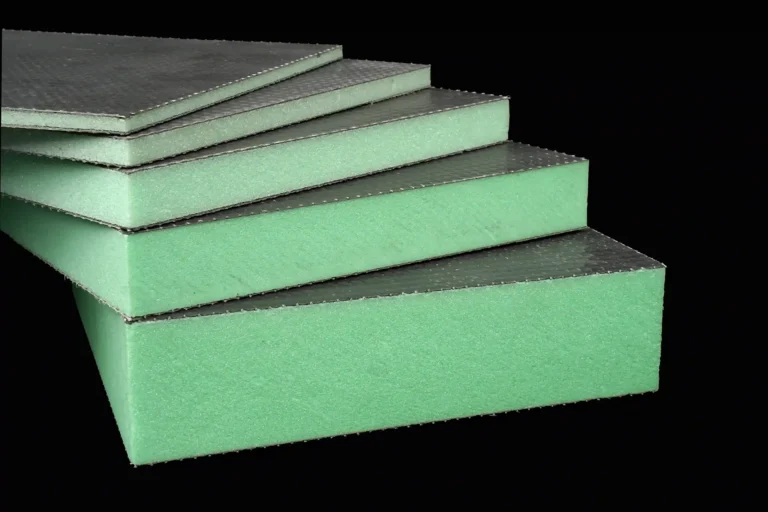
XPS is extruded polystyrene. An XPS waterproof backer board is a three-layer “sandwich”: a rigid, closed-cell XPS foam core, alkali-resistant fiberglass mesh on both faces, and a polymer-modified cement mortar coating on the outside.
- The panel itself is waterproof. Closed-cell foam does not wick or hold water, so there is no separate membrane to add over the face.
- The face is tile-ready. The mesh-reinforced cement coating bonds directly with thin-set; tile goes straight onto it.
- One layer does two jobs. The board acts as both structural backer and waterproofing, instead of hanging cement board and then waterproofing it.
One qualification matters: a single waterproof panel does not make a shower waterproof by itself—the system does. Seams get the manufacturer’s sealant, inside and outside corners get waterproof tape, valve and pipe penetrations get collars, and the walls tie into a sloped pan and drain. Done that way, there is no membrane cure window to wait on. The foam core is light enough to hang solo, cuts with a utility knife and almost no dust, will not rot, feels warmer and quieter, and can be shaped on site for benches, curbs, ramps and niches. It must ultimately be covered by tile or render (it is not UV-stable and is not intended for direct high heat), and floors and heavy tile require the right thickness, fasteners and framing—covered below.
Side-by-Side Comparison
Exact figures vary by brand, thickness and lot; confirm current datasheets for your project.
| Factor | Cement / fiber-cement board | XPS waterproof backer board |
|---|---|---|
| What it is | Rigid Portland-cement (CBU) or cement-fiber panel | Closed-cell XPS core, fiberglass mesh, cement-coated faces |
| Waterproof panel? | No—water-resistant; wet areas need a poly barrier or sheet/liquid membrane | Yes—closed-cell panel will not absorb water; system sealed at seams and penetrations |
| Weight (1/2 in, 3×5 ft) | Heavy, roughly 30–40 lb per panel; often a two-person lift | A fraction of the weight—foam backers are typically around 70–80% lighter; one-person carry |
| Cutting & dust | Score/snap or power saw; respirable crystalline silica; controls under OSHA 1926.1153 | Utility-knife score-and-snap; very little dust; cement faces remain cementitious if power-cut |
| Path to tile | Hang → tape → membrane → detail corners/penetrations → cure → tile | Hang with washer fasteners → seal seams/penetrations → tile (no membrane cure) |
| Mold / moisture | Inorganic board will not feed mold, but passes water to framing if the membrane fails | Closed-cell foam stores virtually no water; protection still depends on a sealed system |
| Insulation / sound | Negligible insulation | Adds a small thermal R-value (reported to ASTM C518); not a rated sound assembly |
| Structural role | Rigid tile backer over proper framing | Not structural—use specified framing spacing, panel thickness and washer fasteners |
| Exposure limits | Must be tiled; tolerates construction exposure better | Must stay covered by tile/render; not UV-stable; no direct high-heat locations |
| Cost | Lowest material cost; adds membrane material, labor and cure time | Higher panel cost; removes the membrane step; often lower installed cost |
| Code & inspection | Accepted through familiar TCNA assemblies with specified waterproofing | The TileBackerPro tileable shower system is listed under ICC-ES PMG-1804 (effective July 2025); install per the listed instructions and the AHJ. |
The Differences That Matter
Waterproofing is the deciding factor
This row drives all the others. Cement board survives getting wet but does not stop water; in a shower it relies on a second product—a poly film behind it or a sheet/liquid membrane over it—to protect the framing. An XPS panel is itself the waterproof layer, so the water-stopping work concentrates at seams, corners, drain and penetrations using one matched system of sealant, tape and collars. Both assemblies can be completely waterproof; the difference is whether waterproofing is a separate operation you add, or built into the panel you are already hanging.
Weight and handling
A 1/2 in, 3×5 ft cement board is a two-handed, often two-person panel, and a shower may need several carried upstairs. A comparable foam panel is light enough to lift, position and fasten overhead alone, and adds less dead load on upper-floor and retrofit work—useful in older homes.
Cutting and crystalline silica dust
Cutting cement and fiber-cement board produces respirable crystalline silica, a regulated hazard. OSHA’s construction silica rule, 29 CFR 1926.1153, specifies dust controls—its Table 1 addresses fiber-cement cutting—along with respiratory protection and an exposure-control plan. XPS slices with a knife and straightedge, so cutting the foam core generates essentially no silica and no saw cloud. Be precise: the thin cement faces are still cementitious, so “significantly less dust than cement board” is defensible; “zero dust” is not.
Mold—and what actually gets wet
Cement board itself will not grow mold—it is inorganic. The risk is behind it: where a membrane is missing, thin or cracked at a seam or drain, water passes through and sits on wood and insulation, where rot and mold occur. Closed-cell XPS does not absorb water, so even if water reaches the panel it is not stored against the framing. Mold is fundamentally a moisture problem, however—no board rescues an unsealed penetration or a dead-flat floor that ponds.
Insulation and sound
XPS adds modest thermal insulation, with per-thickness R-value reported to ASTM C518, which takes some chill off exterior shower walls in cold climates. Do not oversell acoustics: foam backer is not a rated sound assembly, and multi-family or hotel projects still need the floor/ceiling ratings their specs require.
Strength, fasteners and point loads
Cement board is the stiffer, more abuse-tolerant panel. XPS backer board is not structural—it depends on the framing behind it. Installed to the manufacturer’s schedule—typically 16 in on-center wall framing (tighter for large/heavy tile), floor deflection around L/360 for tile and L/720 for natural stone, washer-head fasteners so the foam cannot pull through, and blocking built in for benches, shelves, grab bars and glass doors—it supports ceramic, porcelain and stone finishes without issue. The panel is not the structure; the assembly, built to spec, is what carries the tile.
Cost and schedule
Cement board wins the material ticket; foam panels typically cost more per sheet. The comparison flips on labor: a cement-board shower also buys a membrane, the time to apply it (liquid membranes commonly need multiple coats and dry time), and the detailing around it. A foam system removes that product and its cure window, so crews reach tiling sooner. On one bathroom the saving is a fraction of a day; across a multi-family floor or a hotel block it compounds. Keep price comparisons regional and date-stamped, and compare your own numbers on an installed-cost worksheet.
Code and inspection
Cement board with code-recognized waterproofing is a textbook assembly every inspector knows. XPS systems are accepted when the complete tileable shower system carries recognized listing and is installed exactly per the listed instructions and the applicable plumbing code. The tilebackerpro tileable shower system is listed under ICC-ES PMG-1804 (effective July 2025), evaluated to the IPC, IRC and UPC and the National Plumbing Code of Canada, referencing IAPMO PS 106 for tileable shower receptors and kits; supplied drains must comply with ASME A112.18.2/CSA B125.2. Note the scope: the listing covers the tileable shower system/receptor assembly, not a claim that the panel is approved for every conceivable wall use. Verify the current listing and defer to the local authority having jurisdiction.
Two Assemblies, Step by Step
The fairest comparison counts every step, not just the panels.
Traditional cement-board shower:
- Frame and prep. Frame walls, bench and curb with blocking; prep and pre-slope the floor.
- Hang board. Fasten heavy cement board; tape and fill seams.
- Add waterproofing. Install a poly barrier behind the board or a sheet/liquid membrane over it (liquid membranes often need two coats with dry time).
- Detail. Seal inside/outside corners, the curb top, valve and pipe penetrations, and the drain flange.
- Receptor and drain. Set the pan/liner, connect the drain, confirm slope and weep openings.
- Test, then tile. Pass the required flood/pan test and let the membrane cure before tiling.
XPS waterproof-backer shower:
- Frame and prep. Frame with blocking for fixtures; prep the floor.
- Hang panels. One person can cut (knife) and fasten the lightweight panels with washer-head screws.
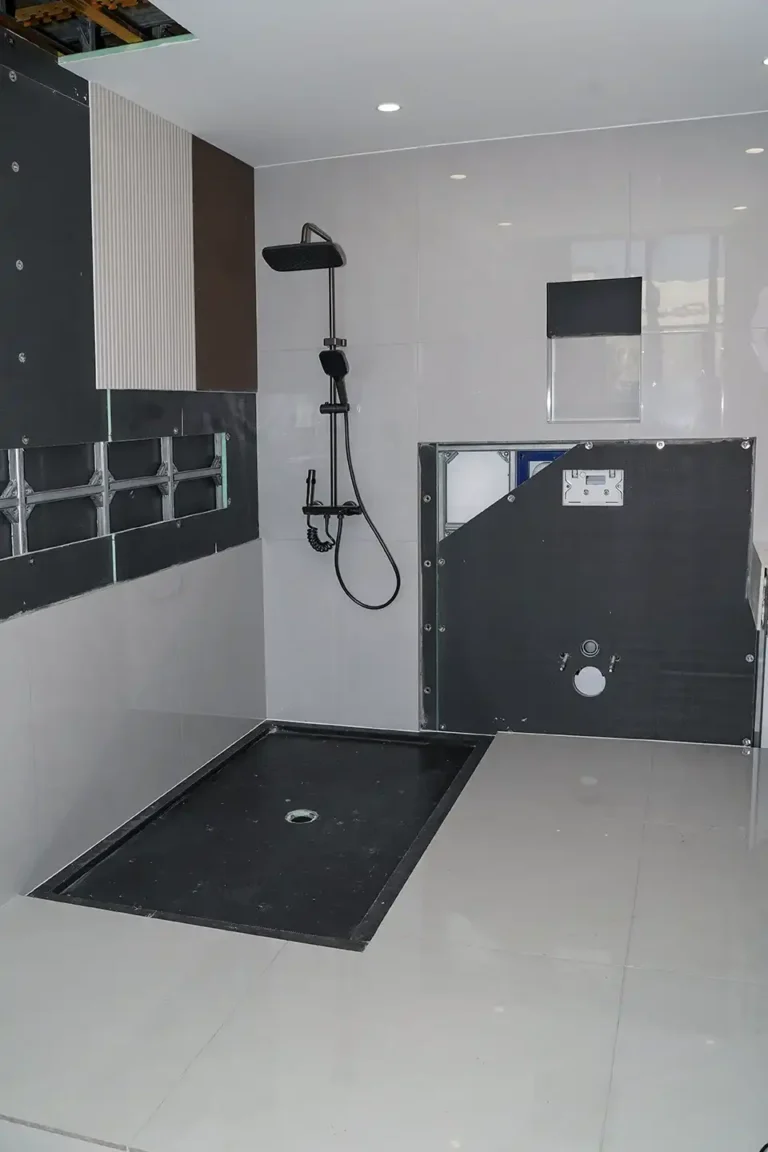
- Seal the system. Seal seams, corners, curb and penetrations with sealant, tape and collars; tie into a factory-sloped preformed pan and drain.
- Test, then tile. Pass the same code-required flood/pan test; once seams are set, tile directly onto the panel face.
What does not change: seams, corners, drain, curb and penetrations still get sealed, and every shower still passes a flood/pan test. Plumbing codes commonly set a minimum water test (often around 15 minutes), while many jurisdictions and manufacturers require a 24-hour or longer test—follow your AHJ. XPS removes the separate membrane product and its cure/dry time; it does not let anyone skip waterproofing detailing.
Failures That Fail the Test (or the Warranty)
- Treating cement board as waterproof. No barrier or membrane over cement board in a wet zone is the classic leak.
- Sealing the field but not the joints. On either system, the failures are at penetrations, corners, the curb and the drain—not the middle of the panel.
- No slope, ponding water. The board choice cannot fix a flat receptor or a blocked weep; the floor and drain are independent of the wall board.
- Wrong foam fastening. Screws without washers pull through; missing blocking behind benches, grab bars and heavy glass means point loads on foam.
- Ignoring thickness and deflection. Large-format tile and stone need the specified panel thickness, framing spacing and floor stiffness.
- Leaving XPS exposed. It must be covered by tile or render, kept out of UV/sunlight, and never used at direct high-heat locations.
- Skipping the flood test. No test, no sign-off—and no early warning before tile goes up.
Which Should You Choose?
Choose XPS waterproof backer board when:
- you want built-in waterproofing rather than a separate membrane
- weight matters—upper floors, retrofits, one-person crews
- schedule matters—hotels, multi-family, modular and repetitive bathrooms
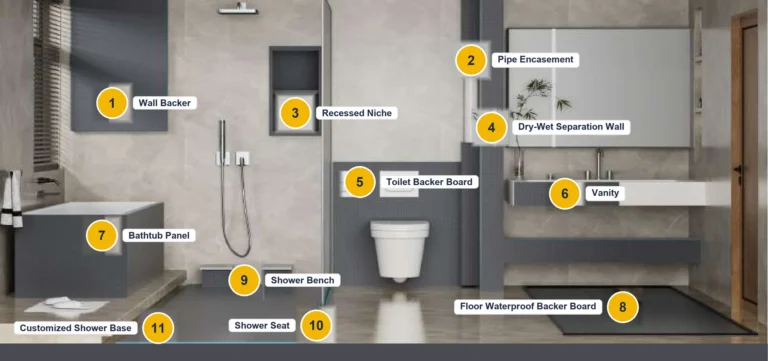
- you are building curbless/accessible showers, benches, niches or ramps from one compatible kit
- low-dust cutting in an occupied home is important
Stick with cement board when:
- your local crew, supplier and inspector build exclusively with cement board and the specified membrane
- material budget dominates and labor/cure time is cheap on that job
- engineered specs, heavy stone or unusual point loads may favor cement board unless the XPS system is engineered and detailed for that load
- the substrate may stay exposed for a long build (XPS must stay covered)
- the location involves direct high heat, or project documents explicitly require cement board
XPS Install Checklist: The Short Version
If you have settled on XPS, the workflow above compresses to a quick checklist:
- Gather the system: panels, preformed pan and matched drain (point or linear), washer-head screws, sealant, waterproof tape and pipe collars.
- Cut with a knife; scribe valve and pipe openings.
- Fasten to solid framing at the specified spacing with washer-head fasteners.
- Seal seams, corners and penetrations, then tie into the pan, curb and drain.
- Tile directly with thin-set after seams are set, following the printed installation instructions for the full wall and room sequence.
Frequently Asked Questions
Do you need a waterproof membrane over cement board in a shower?
Yes. Cement board is water-resistant, not waterproof. In wet zones it is installed with either a poly moisture barrier behind it or a sheet/liquid-applied waterproof membrane over it, with seams, corners and penetrations detailed per the TCNA assembly.
Is XPS backer board waterproof by itself?
The closed-cell panel will not absorb water. The shower as a whole is waterproof only once seams, corners, valve/pipe penetrations and the pan/drain connection are sealed with the manufacturer’s system products.
Is foam backer board as strong as cement board?
Cement board is the stiffer, more abuse-tolerant panel; XPS is not structural on its own. Installed to the specified framing spacing, thickness and washer-fastener schedule—with blocking for point loads—it supports ceramic, porcelain and stone tile.
Can you tile directly onto XPS backer board?
Yes. The fiberglass-mesh-reinforced cement coating is engineered as a thin-set bonding surface, so tile is applied directly to the panel after seams are sealed.
Which is better for a DIY shower?
XPS is lighter, cuts with a knife with almost no dust, and folds waterproofing into the panel, which suits a careful DIYer. Cement board costs less but is heavy, dusty and depends on installing a separate membrane correctly. Both reward precise seam and drain detailing; if your local suppliers and inspector only support cement board, that matters more than material.
Is XPS backer board code-compliant?
The tilebackerpro tileable shower system is listed under ICC-ES PMG-1804 (effective July 2025) to the IPC, IRC, UPC and National Plumbing Code of Canada, referencing IAPMO PS 106. Confirm the current listing and scope in the ICC-ES directory and follow local code and the authority having jurisdiction.
How thick should backer board be in a shower?
Wall panels commonly run 1/4 in to 1/2 in depending on stud spacing and tile load, with thicker panels for floors and heavy tile—always follow the published span and fastener schedule.
Which is cheaper overall?
Cement board is cheaper per sheet. On an installed basis—adding membrane, reinforcement, extra labor and cure time—XPS often costs less, especially where labor is expensive or the same shower repeats. Compare your own numbers on an installed-cost worksheet.
Can XPS backer board be left exposed?
No. It must be covered by tile, stone or render; it is not UV-stable in sunlight and is not intended for direct high-heat locations.
The Bottom Line
You are choosing between two systems, not two boards. Cement board is a proven structural backer that asks you to add waterproofing as a separate, time-consuming step. XPS waterproof backer board combines the backer and the waterproof layer in one light, tile-ready panel, and becomes a fully listed shower once its seams and connections are sealed as a system. Choose XPS for fewer steps, far less weight and dust, and factory-controlled waterproofing; choose cement board when your specs, crew or budget are built entirely around the traditional assembly—and you will install the membrane correctly.
References & Notes
- ICC-ES Product Certificate PMG-1804, Tileable Shower Systems with Backing Board, (Listee name withheld on site; certificate verifiable by number in the ICC-ES PMG Listing Directory.) Effective July 2025. ICC Evaluation Service (verify by certificate number in the ICC-ES PMG Listing Directory).
- ICC-ES PMG Listing Directory, ICC Evaluation Service.
- OSHA 29 CFR 1926.1153, Occupational Exposure to Respirable Crystalline Silica (Table 1), U.S. Occupational Safety and Health Administration.
- ASTM C518, Standard Test Method for Steady-State Thermal Transmission Properties by Means of the Heat Flow Meter Apparatus, ASTM International.
- TCNA, Handbook for Ceramic, Glass, and Stone Tile Installation (current edition), Tile Council of North America.
- IAPMO PS 106, Tileable Shower Receptors and Shower Kits, International Association of Plumbing and Mechanical Officials; ASME A112.18.2 / CSA B125.2 (plumbing drain/waste fittings). Board seams and penetrations are sealed with the manufacturer’s specified sealant and tapes.
- Always install to the current manufacturer instructions and the code enforced by your local authority having jurisdiction (AHJ).
Contact us
Email: an@tilebackerpro.com
Website: tilebackerpro.com
Planning a wet room project?
Tell us your wall type, tile format and quantities — we will confirm the board specification and send you a project sample kit.