For TileBackerPro boards, the standard XPS backer board density is 35 kg/m³ for the foam core. Other densities can be produced to order. That number is useful, but it does not by itself prove compressive strength, water resistance or the performance of a finished wet room.
Here is what the density number means, what it leaves unanswered, and how to check a sample without turning a kitchen scale into a false certificate.
What density does tell you
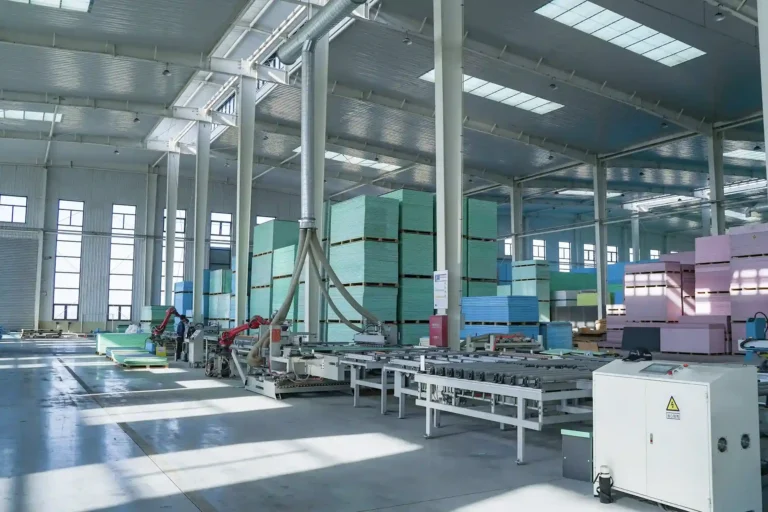
Density is the mass of the extruded core divided by its volume. At our factory, 35 kg/m³ is the standard extrusion setting, not a number copied from a competitor’s brochure. We extrude our own XPS cores, so the target starts at our production line.
A higher density target generally means more polymer per cubic metre. Within a comparable material and process, it can correspond with higher compressive strength and a more robust cell structure. That relationship is useful, but it is not a universal conversion table. Cell structure, raw material composition and extrusion control still matter.
Own extrusion gives us direct process control. It does not remove the need for production records, representative samples and test evidence. A supplier using externally produced cores can also control quality through specifications and inspection. The useful question is not where the foam came from; it is whether the supplier can demonstrate control of the agreed target.
What density does not tell you
Density is not a strength test. Two boards with the same nominal core density can perform differently if their cell structures or production conditions differ. Specify the required mechanical property and review its test result instead of assuming that density has already answered it.
Density is not waterproofing. Water behaviour depends on the closed-cell core, the coated faces and the complete joint and penetration system. Our factory data records water absorption of 0.8% by weight after 96 hours of immersion under the stated test condition. That result belongs to the tested material and method; it does not automatically apply to every custom density.
Nor does density describe coating adhesion, dimensional stability or the finished wall. A high-density core joined with incompatible tape or sealant still leaves a weak interface. Density describes the core. Procurement has to review the board and the assembly as well.
What our standard 35 kg/m³ means on an order
Our standard core density is 35 kg/m³. If the project needs another target, send the application and specification before production so we can confirm feasibility, the order target and the available evidence.
The order should distinguish a nominal target from an acceptance range. It should also state whether the figure refers to the core alone or to the coated board. Those are not interchangeable measurements. The cementitious faces and reinforcement add mass, so a coated board’s mass divided by its total volume gives an average board density, not the XPS core density.
For the wider procurement checklist, our questions to ask before ordering puts raw material, test evidence and consistency alongside the density figure.
Density and the raw material question
For export boards, our stated specification is at least 80% virgin raw material. That is a material statement, not a density result and not a substitute for mechanical or water-absorption testing.
Raw material composition, extrusion settings, cooling and process control can all influence consistency. Recycled content should be assessed through the agreed specification and quality controls rather than automatically treated as either acceptable or unacceptable. Put the material requirement in writing, then ask what evidence can be supplied for the order.
How to screen a sample properly
Mass divided by volume is simple arithmetic. Getting a meaningful core sample is the part that needs care.
- Use a core-only sample with regular geometry and measure its length, width and thickness accurately. A larger sample reduces the effect of cutting and measurement error.
- Use a scale with resolution suited to the sample mass. Do not rely on a small sample whose mass is close to the scale’s readability.
- Calculate volume in cubic metres, then divide mass in kilograms by volume. State the sample condition and method with the result.
- Treat site weighing as a screening check. Formal acceptance should follow the agreed test method and representative report.
A hypothetical 300 × 300 × 20 mm core sample has a volume of 0.0018 m³. If it weighs 0.063 kg, the calculated density is 35 kg/m³. By contrast, a 100 × 100 × 10 mm core at the same density would weigh only about 3.5 g, which makes an ordinary 1 g scale a poor choice for a reliable check.
Do not weigh a coated offcut and call the result core density. If only a coated board is available, record the result as an average for that complete sample and keep it separate from the core specification. Our guide to what management systems can and cannot prove explains why the document behind a number matters as much as the number itself.
What to write into the purchase order
If density matters to the project, define it before production:
- The nominal target or acceptance range for the core, including any agreed tolerance.
- The measurement method, sample dimensions, conditioning and whether coatings are excluded.
- A test report that identifies the sample, product and method and is representative of the order. A separate density report for every thickness is not automatically necessary; relevance and representativeness are the real tests.
- The raw material statement and the order or batch evidence that both sides agree to retain.
- The receiving-sample procedure, including sample size, equipment resolution and how a disputed screening result will be confirmed.
This turns a brochure number into something both teams can verify.
The evidence to review beside density
For a wet-area board, density belongs in a wider evidence set. Our factory data includes compressive strength of 361 kPa at 10% deformation and layer bond strength of 0.42 MPa under their respective stated conditions. These values belong to their samples and methods; they are not automatic results for every custom density or every wall assembly.
Review the coating and joint materials as a specified system, and check the framing, fixing, penetrations and project requirements. The 4-50 mm XPS tile backer board range covers different thicknesses, but thickness and density remain separate decisions.

The short version
Our standard core density is 35 kg/m³, with other densities available to order. Use that number as one line in the specification, not as the whole verdict. Confirm what was measured, how it was measured and which report represents the order, then review the coating, joints and installation system beside it.
FAQ
Is a higher density board always better?
Not automatically. Density can relate to compressive behaviour within a comparable material and process, but the required property should be specified and tested directly. The right target depends on the application and the complete assembly.
Does density make the board waterproof?
No. Density and water absorption are different properties. Water behaviour also depends on the closed-cell core, coated faces, joints and penetrations.
What density do your boards come in?
Our standard XPS core density is 35 kg/m³. Other densities can be produced to order, with the target, tolerance and supporting evidence confirmed for the order.
Can I verify density myself?
You can screen a measured core-only sample by dividing mass by volume, using suitable sample dimensions and scale resolution. A coated-board result is an average for the complete sample, not core density. Formal acceptance requires the agreed method and representative evidence.
Is 35 kg/m³ a universal industry requirement?
No. It is our standard production target and may also suit a project specification, but it is not a universal requirement for every board or application. Confirm the required properties and evidence rather than treating one number as a global rule.
Your turn
Tell us the application, the load conditions and the density written into your specification. We will confirm the target, measurement basis and available test evidence within one working day. Ask for a Project Sample Kit if you also want to inspect and measure the board before you commit.
Send your specification for review | See the wet-room applications | Review the seven buyer questions
Checking a board before you commit?
Send your application, load conditions and target market. We will confirm the density target, measurement basis and available test evidence. Ask for a project sample kit if you also want to inspect the board yourself.