No single certificate in a supplier’s folder proves the product is good. Each document answers a different question, and most vetting fails because the buyer asks one question while the folder answers another.
We are in a fair position to show the difference, because we hold all three kinds of evidence ourselves. So this article does not describe certificates in the abstract. It walks through our own folder, document by document, including the points where our own papers stop being evidence. Learn to read ours this way, and you can read anyone’s in ten minutes.
My supplier sent a folder of certificates. Which one proves what?
Every certificate folder answers three questions, and only three:
- Management system certificates (our ISO 9001, 14001 and 45001) answer: does this factory run its operation consistently, year after year?
- Product and system listings (our ICC-ES PMG-1804 and CE marking to EN 13164) answer: has a recognized third party evaluated this product or system against published criteria and code?
- Test reports (our IAPMO PS 106 report J251017003-1) answer: what did the actual tested samples do in the lab, under stated conditions?
| Kind of evidence | Question it answers | What it can never tell you |
|---|---|---|
| ISO 9001 / 14001 / 45001 | Will the factory be consistent next year? | How any single board performs |
| ICC-ES PMG-1804 / CE EN 13164 | Is the system recognized against code, and within what scope? | Whether this morning’s batch passed |
| IAPMO PS 106 report | What did the tested samples do under stated conditions? | What an untested size or site condition will do |
Keep those three questions separate, and every tile backer board certification you will ever be shown becomes easy to read.
ISO 9001, ISO 14001, ISO 45001: what a management system certificate actually proves
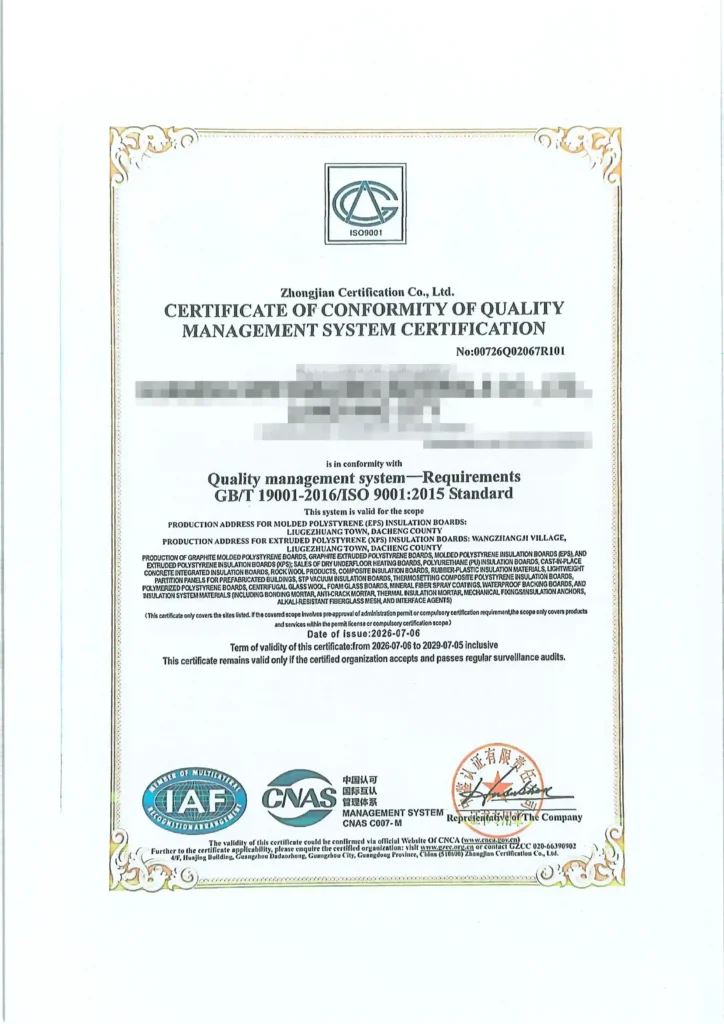
Our factory holds three management system certificates: ISO 9001:2015 for quality (certificate no. 00726Q02067R101), ISO 14001:2015 for environment (00726E01486R101) and ISO 45001:2018 for occupational health and safety (00726S01393R101), issued by Zhongjian Certification with CNAS C007-M and IAF MLA marks, valid from July 2026 to July 2029. The certification scope covers XPS extrusion board and waterproof backing board production, which is exactly the material in our boards.
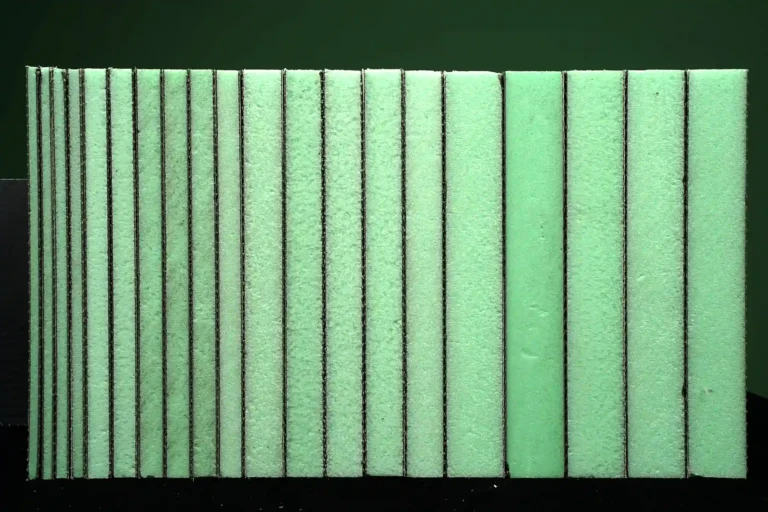
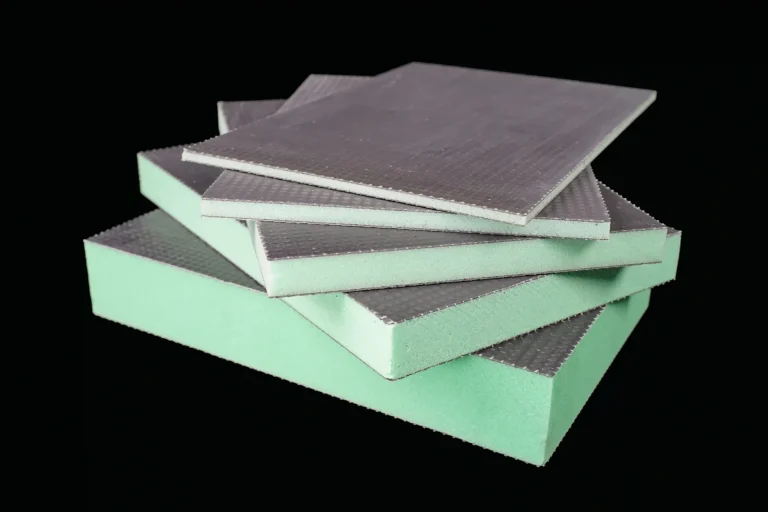
Here is why this matters to a buyer, in concrete terms. We extrude our own XPS core. The standard core density, 35 kg per cubic meter, is a setpoint on our extrusion line, not a label we stick on someone else’s foam. Density is what drives thermal performance, dimensional stability and closed-cell structure, and therefore how the board behaves after five winters in a heated floor. A setpoint is easy to type into a control panel on day one. What keeps it honest on a Tuesday night shift in August, with a different crew and raw material from a different delivery, is the management system behind it: recorded raw material intake, batch traceability, calibrated instruments, corrective actions when a number drifts.
That is what the ISO certificates attest to. Auditors do not test boards; they test whether the factory’s way of working produces the same result regardless of who is on shift. They look at document control, training records, nonconformance handling and whether a problem found in March is still fixed in September. The certificates stay valid only while the factory passes periodic surveillance audits.
What the ISO certificates do not prove is the performance of any single board on any single day. A management system certificate is like a restaurant’s hygiene certificate: it tells you the kitchen is run properly. It says nothing about whether tonight’s dish is good. That job belongs to listings and test reports.
One wording error to watch for, because it appears constantly in supplier brochures: there is no such thing as a “CE-certified factory.” CE marks products against a standard; it is not a factory management award. When a supplier blurs that line, either they do not know the difference or they hope you do not. Our redacted certificates, with numbers you can verify, are on our About page.
ICC-ES PMG-1804: what a code listing adds that a test report cannot
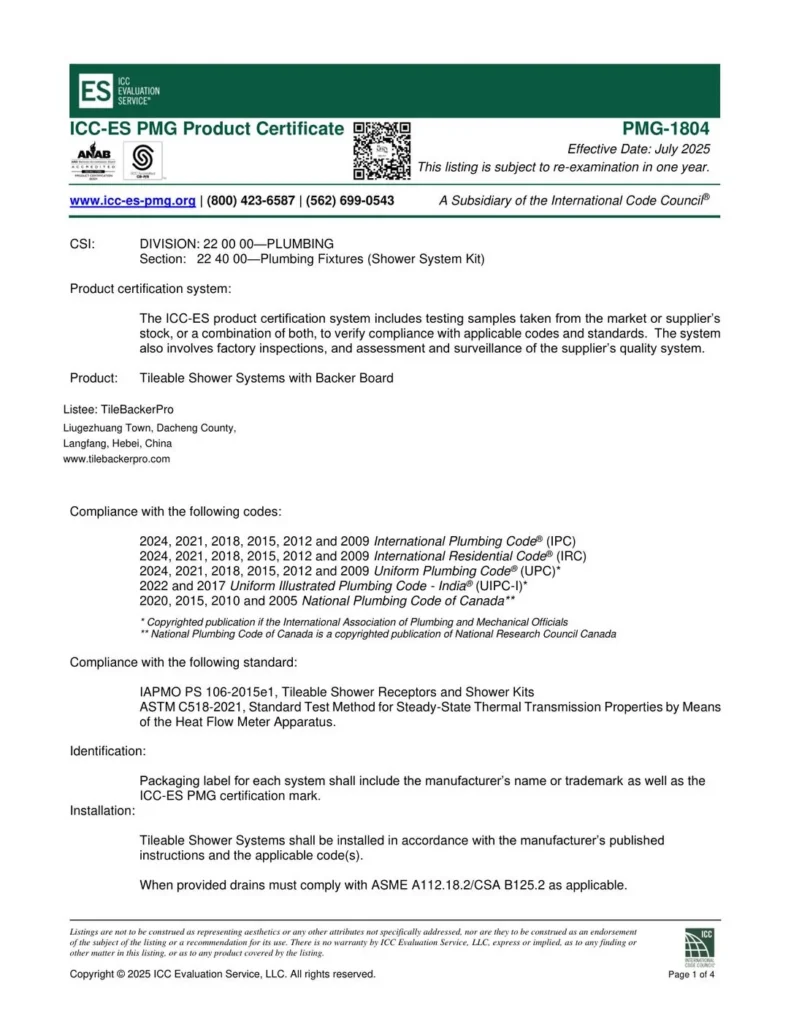
Our tileable shower system is listed under ICC-ES PMG-1804, effective July 2025 and renewed on an annual cycle. If you have not worked with ICC-ES before: it is an evaluation service that assesses building products against the model plumbing and building codes, and a PMG listing means a published, numbered evaluation exists that code officials can look up. The PMG program itself is accredited by ANAB and the Standards Council of Canada, and every certificate is issued subject to re-examination within one year, which is the formal basis for the annual renewal we mentioned above.
The coverage list is the part buyers usually skim and should not. The listing addresses the model code versions actually in force across the major North American markets: IPC, IRC and UPC from 2009 through 2024, the Canadian National Plumbing Code across its versions, and India’s Uniform Illustrated Plumbing Code from 2017 and 2022. If your project cites a code, you can check whether the listing speaks to that version instead of trusting a sentence like “meets international standards.”
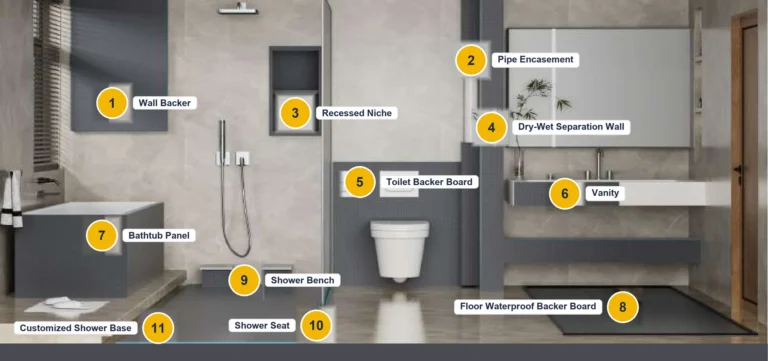
Two more details separate a listing from a marketing claim. First, it is maintained, not granted once: the program includes annual renewal, factory inspections and continued surveillance of the quality system. Second, it has a written scope. PMG-1804 covers the tileable shower system with backing board: shower trays, wall boards, curb and slope pieces, niches, benches, drain components and the accessories that complete the assembly. It is not a claim that a panel is approved for every conceivable wall use, and we do not write it that way. The certificate itself carries the condition that the system is installed per the manufacturer’s instructions and the applicable code, with the local authority having jurisdiction as the final word.
Notice what just happened in this section: every sentence could be checked by a stranger. Certificate number, effective date, code versions, scope, renewal conditions. That checkability is the entire point of a listing, and it is the standard we suggest you hold every wet-area supplier to. The practical code side of this, including where traditional cement board still belongs, is covered in our long comparison of cement board vs XPS waterproof backer board.
CE marking to EN 13164: read the scope line, not the logo
Buyers from Europe usually ask about CE first, and the CE story rewards a careful reader. Our applicable boards and wet-room elements carry CE marking to EN 13164:2012+A1:2015, the European standard for factory-made thermal insulation products, under certificate SC-PSC-4-2025-06-06, issued on 10 June 2025 and valid to June 2028. The legal route is Regulation 305/2011/EU under AVCP System 4, and here is the part most brochures skip: System 4 is full manufacturer self-declaration. No notified body is involved at any stage. The manufacturer carries out its own testing, operates its own factory production control, and draws up a Declaration of Performance on its own responsibility. The legally binding document is the DoP, not the logo, and the certificate number is how you identify the product scope and the body behind it.
Be honest about what this means. A CE mark under System 4 and an ICC-ES listing are not the same kind of evidence. One is a self-declaration with the manufacturer’s own system behind it; the other is a third-party program with factory inspections and quality system surveillance that continues after certification. Both have their place. A buyer who treats a CE logo as equivalent to a listing is comparing a declaration with an audit, and suppliers who encourage that confusion know exactly what they are doing. This is also where a management system certificate earns its keep: under System 4, the discipline that keeps self-declaration honest is the factory’s own audited quality system, which is precisely what the ISO trio in the previous section attests to.
The scope line, again, is where the information lives. It lists the product families: waterproof insulation composite boards including wall and building boards, shower trays, single-slope trays, extension pieces, curbs, niches and benches. If you are buying a product family that is not on the scope line of the certificate you were shown, the logo on the brochure is decoration, not evidence.
And the same honesty rule as before applies: CE is product marking under a named standard, not a factory popularity award. “Our factory is CE certified” is a category error the way “our board is ISO certified” is. Suppliers who mix the categories in writing will usually mix them in shipping documents too.
IAPMO PS 106 report J251017003-1: this is where the numbers come from
The third document is the one engineers usually flip to first. Report J251017003-1, issued on 28 January 2026, records testing of our tileable shower system to IAPMO PS 106-2015, the standard for tileable shower receptors and shower kits. Testing ran from October 2025 into January 2026. This is not an obscure industry standard: the 2024 Uniform Plumbing Code names PS 106 in its referenced standards and requires field-installed tileable and pre-tiled shower kits to comply with it. In UPC jurisdictions, this report is not marketing material; it is the code-named evidence for exactly the product category you are buying.
Start with the sentence most suppliers get wrong. The report lists 71 models: wall boards, trays, curbs, extension pieces, niches, benches and drain components. It also identifies which specific samples were tested. The correct statement is that 71 models are listed and the tested samples are identified, not that all 71 models were individually put through every test. Any brochure claiming the latter is overselling the document, and a sharp buyer should notice.
The tested samples, under the stated conditions, did the following:
- Compressive strength: 395 kPa measured, against a requirement above 248 kPa.
- Flexural strength: 5,481 kPa measured, against a requirement above 1,462 kPa. The unit here is kPa, a stress. Do not compare it directly with a bending load reported in newtons; that is a different test geometry and the numbers are not interchangeable.
- Linear expansion: 0.02% measured, against a limit of 0.07%.
- Structural load: 1,335 N applied through the specified disc and loading procedure, a shower receptor load test. The tray held with no cracking, no damage and no leakage at the wall-floor joint.
- Spray test: 40 °C water for 30 minutes at 11.4 L/min, sprayed from 1.2 m at a 45-degree angle. The assembly passed with no failure.
- Further applicable clauses were recorded as Comply or Pass, including shear bond, hydrostatic pressure, mold resistance, drain connection, point impact and wall-area impact.
The report also covers the drain components, and this is where scope discipline matters. The drain bodies are SUS304 stainless steel; after 96 hours in a 5% salt spray they remained functional. Measured drain flow exceeded 27 liters per minute, and the drain cover carried a 1.3 kN load for two minutes through a 50 mm platen without cracking beyond the criteria. Those are drain component results. Writing them onto the board would be exactly the category error this article is about.
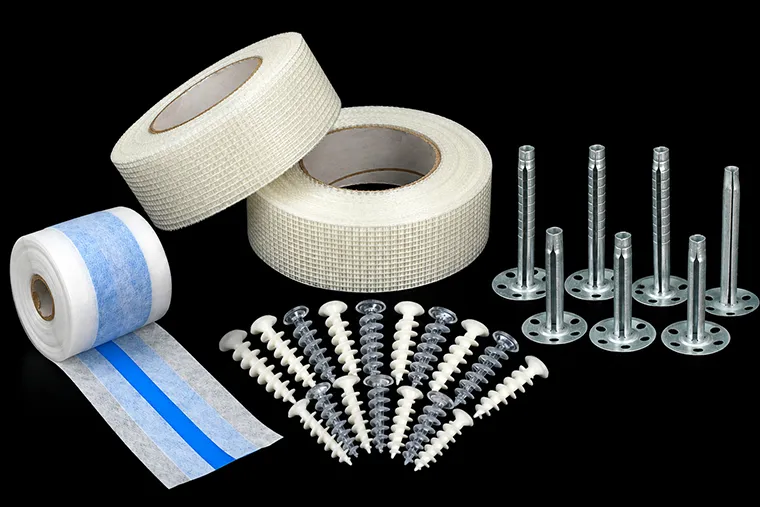
One more boundary worth knowing because it surprises people: parts of the PS 106 testing were carried out with the sealant as specified by the system, and the report marks where a sealant sample was not provided. Our ICC-ES system documentation describes the system sealant that completes the listed assembly. The practical lesson for the jobsite is simple: the board is one component of a certified system, and the sealant, tape and drain connections are where the listing is won or lost.
Finally, the mixing rule. Where our factory brochure lists other values, such as 361 kPa compressive strength at 10% deformation or a 1,842 N bending load for a 12 mm board, we present them as factory data, because they come from different test regimes and must not be blended with the IAPMO results into one number soup. A supplier who piles every number from every document into one brochure page is telling you something about how they will treat your specification.
How do I verify a supplier’s certificates in ten minutes?
When you receive a certificate folder from any wet-area supplier, including us, work through five checks:
- Look up the number. ICC-ES listings are verifiable by certificate number in the ICC-ES PMG Listing Directory. ISO certificates are verifiable through the issuing certification body and its accreditation marks. The CE certificate carries a number that identifies the product scope and the body behind it. A document with no verifiable number is a claim, not evidence.
- Read the scope paragraph, not the logo. Does it cover the product family you are actually buying, in the market you are building in?
- Check the dates and the renewal conditions. An expired listing, or one where the surveillance condition is hidden, tells you about last year, not next year.
- Ask why any redaction exists, and expect a specific answer. Our published certificate copies are redacted to protect the legal entity behind the production, and we will explain exactly what was removed and why. A factory can always explain its redactions; a folder reseller usually cannot.
- Ask one technical question about the document itself. For our PS 106 report, ask which samples were tested. A factory answers from the report; a trader stalls, or sends you the brochure again.
Five checks, ten minutes. They will eliminate most of the wet-area supply chain for you, which is rather the point.
What no certificate protects you from
Here is the part that saves you money, so read it slowly. Every document in this article describes the factory and the product as tested. None of them installs your shower.
Field failures in wet rooms overwhelmingly trace back to three things. Joints and penetrations that were not sealed as a system. Brands mixed across the build: one maker’s board, another maker’s tape, whatever sealant was in the van, which is how a project ends up with three seams opening in the same month eighteen months later. And thickness chosen by budget instead of by stud spacing, because a 6 mm board on wide-spaced studs under heavy tile will flex, and a flexed board eventually cracks somewhere you cannot see.
Our ICC-ES listing covers a system, and the system includes the sealant, the tape, the screws and washers, and the drain connections, installed in sequence. That is why we route buyers to the full accessory system rather than boards alone. The board is the easy part; the last thirty percent of the system is where waterproofing is won. And the thickness decision, the one that prevents the cracked tile in year two, is covered in our thickness guide.
Certificates describe the factory and the tested samples. Your shower gets built on site. Plan accordingly.
So which document should I ask for?
It depends on who is asking:
- If you are a contractor or installer, start with the ICC-ES listing and the PS 106 report. Code recognition and tested performance are what protect you on the job site and at inspection.
- If you are a distributor or importer, add the ISO trio. You are not buying one shower; you are buying next year’s consistency, and that is what a management system certificate is for.
- If you are buying private label or OEM, you need all three plus one more conversation: whose factory production control does the CE rest on, and does the listing survive a change of brand on the packaging. Certificates follow the production entity, not the label.
- If you are an architect or specifier, the listing scope sentence and the code version list are your working documents; everything else is supporting cast.
- If you are a homeowner, the listing scope and the installation manual matter most, because most field failures trace back to joints, penetrations and sequencing, not to the panel itself.
One sentence to keep: the management system tells you the factory will be consistent next year; the listing tells you the system is code-recognized within a written scope; the test report tells you what the sample did in the lab. All three together, and none of them replaces correct installation.
Three red flags when reading a supplier’s certificate folder
- Scope blur. A certificate for one product family or one factory presented as if it covers everything the supplier sells.
- “Meets the standard” with no listing number and no report number. Anyone can type that sentence. A listed product has a number you can verify in a public directory.
- Category errors. “CE-certified factory.” “ISO-certified board.” “IAPMO-approved company.” These mix up the three kinds of evidence, and they are the fastest way to tell a trader’s slide deck from a factory’s file.
Your turn
Send us the market you are buying for and the certificates your project requires, and we will confirm which listings and reports apply to your specification, then put a project sample kit in the mail: board offcuts, sealing tape, sealant and a drain fitting, so you can handle the material and read the same documents this article quotes.
Get the sample kit or send your certificate questions | Browse the wet-room applications | Run the UK buyer’s seven questions
Vetting a backer board supplier for a wet-area project?
Tell us which market you are buying for and which certificates your project requires — we will confirm the applicable listings and test reports and send you a project sample kit.