Mixed container loading starts with the actual bill of materials, not with full-container quantities copied from separate product tables. A board-only reference quantity describes one defined loading scenario. Once trays, niches, benches, curbs and accessories enter the order, the pallet positions, packaging and protection plan all change.
That is why mixed quantities cannot simply be added together. The useful question is how this exact combination fits, travels and gets unloaded.
Why full-container board quantities do not mix arithmetically
Our existing 40HQ reference plan uses approximately 68 m³ of internal volume and about 27.5 m² of floor area, with an eight-pallet arrangement for 1220 × 2440 mm boards. The quantities by thickness are planning values for that standard board-only scenario.
They are not a universal conversion table. A pallet containing several thicknesses may have a different stable stack height from a single-thickness pallet. A smaller board format may use the pallet footprint differently. Trays and preformed elements introduce shapes that cannot be treated as flat board area alone.
Use the full-container figures as reference points, then rebuild the plan from the mixed order. Our 40HQ board-size planning guide explains the baseline for standard boards; this article deals with the next step.
Step 1: Freeze one order BOM before calculating
The loading plan should use the same revision as the purchase order. List every line with product name, model, length, width, thickness, quantity and packaging unit. Separate boards, shower trays, niches, benches, curbs, drains, sealant, tape and fixing accessories instead of grouping them under one wet-room total.
Add the destination port and trade terms to the commercial review, but keep the physical loading list tied to product dimensions and packaging. If a model or quantity changes, revise the loading plan rather than leaving the old pallet map attached to a new order.
For inch-size lines, keep the actual specified format visible. Do not silently convert an inch product into a nearby millimetre product for loading convenience. Our US inch and metric board-size guide explains why those product identities should remain distinct.
Step 2: Group products by real handling constraints
Start with the items that control the layout:
- Large board pallets and their permitted stacking arrangement.
- Preformed trays, including drain zones and any projections that need protection.
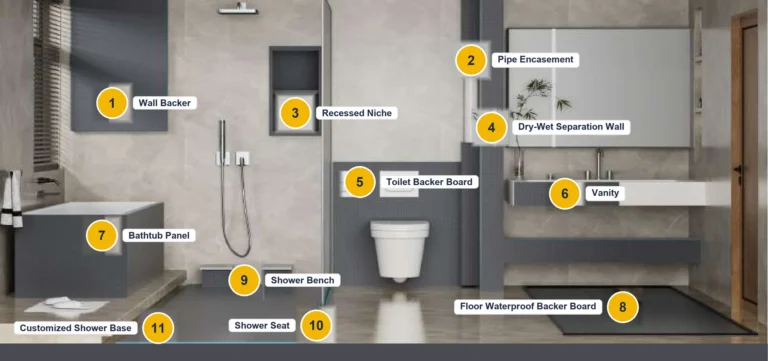
- Niches, benches and other three-dimensional elements that need void fill or separate cartons.
- Small accessories that must remain identifiable and cannot disappear between large pallets.
- Any product with a specific orientation, moisture-protection or unloading requirement.
Do not assume that trays can be nested, that niches can fill every gap, or that accessory cartons can carry pallet weight. Those decisions depend on the actual product geometry and packaging approval.
The goal is not to eliminate every visible void. The goal is a stable, protected load that can be checked and unloaded without damaging the order.
Step 3: Build the pallet and floor plan together
A mixed-load spreadsheet should show what sits on each pallet or handling unit, its footprint, stack arrangement and package count. The floor plan then shows where those units sit in the container.
The eight-pallet reference arrangement is a starting layout for the standard board scenario, not a promise that every mixed shipment will use exactly eight pallets. Some orders may need different handling units or reserved space for preformed elements.
Record unused space as unused space until the packaging review proves that an item can occupy it safely. Filling a drawing to 100% is not the same as producing a loadable plan.
Step 4: Give trays, niches and drains their own protection plan
Shower trays need protection around the formed surface, edges and drain area. Niches and benches need their geometry preserved rather than being squeezed into residual gaps. Drain bodies, grates and small sealing components need labelled packaging that can be counted at arrival.
Separate three questions in the plan:
- How is each item protected from contact, movement and crushing?
- How is its package identified against the order line and installation set?
- When will it be removed at destination, and what must be accessible first?
A drain kit buried beneath the last pallet to come off can hold up the installation even when every physical item arrived. Package identification is part of loading quality, not an administrative extra.
Step 5: Confirm weight and carrier rules separately
Volume and floor area do not complete the compliance check. Gross package weights, axle or point-loading considerations, container limits, securing requirements and carrier rules need their own confirmation using the final packing data.
Do not borrow a tonnage from an older spreadsheet if the product mix or packaging has changed. Our current internal weight records are not consistent enough to publish a universal loading limit, so this guide deliberately uses no tonnage figure. The final plan must use confirmed order weights and the carrier’s applicable rules.

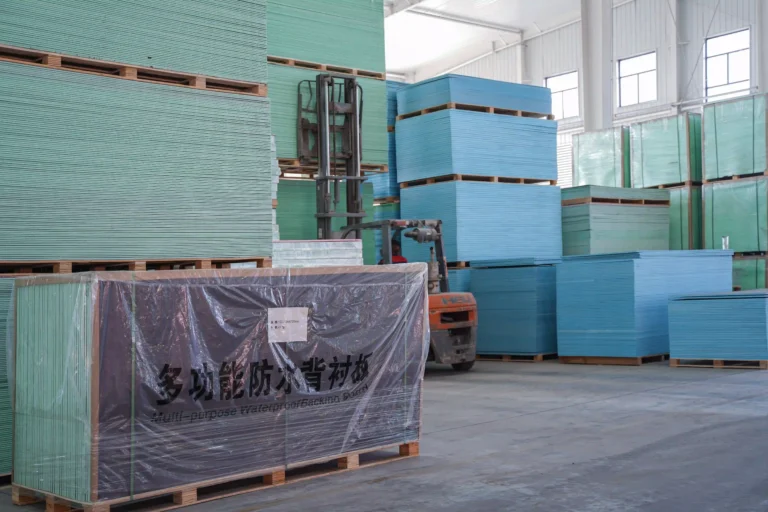
This image is a planning-context photograph, not a record of a specific mixed container. The actual shipment still needs its own packing list, pallet map and confirmed weights.
Step 6: Plan the unloading sequence before closing the doors
Loading order should reflect restraint, protection and destination handling. Heavy or stable units, fragile formed elements and first-needed installation accessories should not be positioned by guesswork.
Mark the pallet and carton IDs on both the packing list and the container map. If the order will be split across rooms or project phases at destination, consider grouping the relevant components so the receiver can find them without unpacking the entire shipment.
Also confirm who checks the final load against the approved map and what photographs or records are required. A photograph can document visible placement and packaging, but it does not replace the signed quantity and weight records.
What to send for a mixed-load review
Use this input checklist instead of asking only “How much fits?”:
- Product BOM with model, dimensions, thickness and quantity for every line.
- Board format and any mixed-thickness or mixed-size combinations.
- Tray, niche, bench and curb models with their packaging requirements.
- Drain, sealant, tape and fixing-accessory quantities by package.
- Destination port, trade terms and any delivery or unloading constraints.
- Confirmed package weights and the applicable carrier requirements when available.
With those inputs, a container plan becomes a project document: line items, pallet IDs, package counts, placement, protection and open checks. That is what a mixed order needs.
FAQ
Can I add percentages of different full-container board quantities?
Only as an early rough discussion, not as the final loading plan. Mixed thicknesses, board formats, preformed elements and packaging change the usable pallet and container layout. Recalculate from the actual BOM.
Does every mixed 40HQ order use eight pallets?
No. Eight pallets is the reference arrangement for our standard 1220 × 2440 mm board-only planning scenario. A mixed order may need different handling units and reserved space for trays, niches or other elements.
Can niches and accessories fill all the spaces between board pallets?
Not automatically. Their packaging, crush protection, orientation and unloading access must be reviewed first. A space on a drawing is not necessarily a safe storage position.
Why is there no universal weight limit in this guide?
The final gross weights and applicable carrier rules must be confirmed for the actual order and packaging. Our internal historical weight records are inconsistent, so we do not publish a generic tonnage figure from them.
What information is needed for a usable loading plan?
Send the full BOM, product dimensions and models, quantities, packaging details, destination and handling constraints. Confirmed weights and carrier requirements complete the final review.
Your turn
Send your mixed-order BOM, board formats, tray and niche models, accessory quantities and destination port. We will turn that list into a container-by-container loading proposal within one working day, with unresolved packaging or carrier items marked for confirmation. You will see what sits together before the order is released.
Send your mixed-order BOM | Review boards and wet-room elements | Start with the standard 40HQ board plan
Planning a mixed board and wet-room shipment?
Send your BOM, product sizes, tray and niche models, accessory quantities and destination port. We will confirm the product specification and build the mixed-load proposal. Ask for a project sample kit if product approval is still open.